Bow, Stern, Port, and Starboard: A Clear Map of a Vessel
Learn bow, stern, port, and starboard from a vessel’s own orientation, so dockside directions stay clear as a boat turns, backs, or changes course.
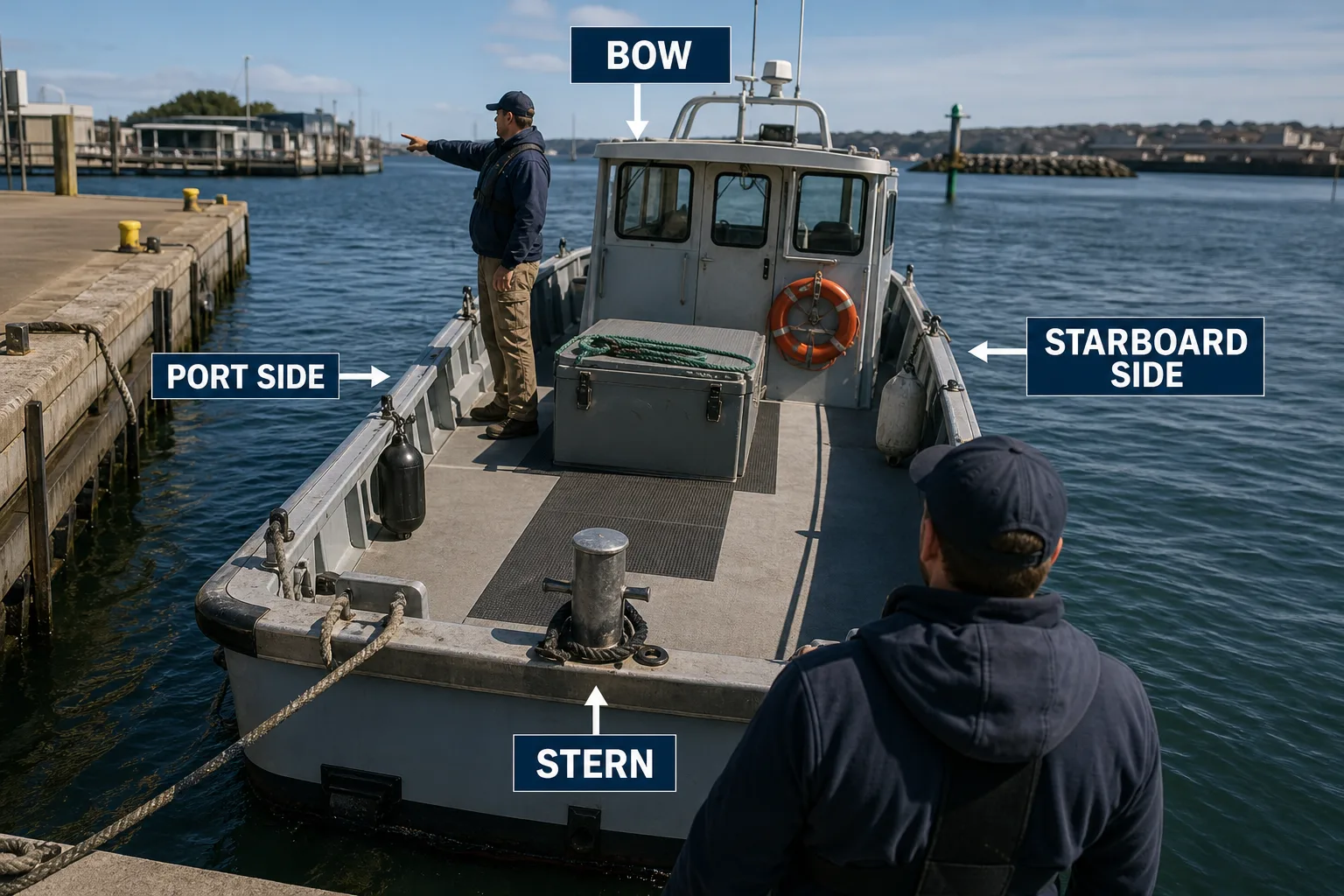
At a marina, two people point from opposite sides of a tied-up boat and both say, “Move it to the left.” Bow, stern, port, and starboard avoid that kind of confusion because they describe a vessel from its own orientation, not from where a person happens to stand. A clear map of these directions begins with the boat itself.
Imagine a clearly hypothetical situation: a new deckhand named Sam is helping move a small workboat from a berth to an open fairway. The skipper calls for a line from the port side, then asks Sam to watch the stern while the bow swings around. Sam knows the ordinary meanings of “front,” “back,” “left,” and “right,” but those words seem to change as the boat turns. The task is to anchor each nautical term to the vessel, then use that frame consistently.
The Vessel’s Fixed Frame
A vessel has a fore-and-aft line running along its length. The bow is the forward end; the stern is the aft end. These terms stay attached to the hull even when it is turning, drifting, or backing toward a dock.
Port and starboard name the vessel’s left and right sides when someone aboard faces forward, toward the bow. They do not mean the left and right sides of a person looking at the vessel from the dock. That distinction is the foundation of a dependable onboard vocabulary.
- Bow: the forward end of the vessel.
- Stern: the aft end, opposite the bow.
- Port: the vessel’s left side when facing the bow.
- Starboard: the vessel’s right side when facing the bow.
For a quick orientation check, stand or imagine standing near the centerline and face toward the bow. Your left hand points to port; your right hand points to starboard. Turn around on the dock, and your own left and right swap in relation to the vessel, but the vessel’s port and starboard do not.
Directions That Stay Put
The terms are fixed to the hull, not to the vessel’s direction of travel at a particular moment. If a boat backs out of a berth, its stern may lead the movement, but the stern remains the stern. Port does not become starboard simply because the boat is moving astern.
It helps to separate three ideas that often get blurred together: which part of the vessel someone means, which side of the vessel they mean, and which way the vessel is moving. Bow and stern identify ends. Port and starboard identify sides. “Ahead” and “astern” describe movement relative to the vessel’s forward direction.
Those distinctions matter during a turn. The bow can swing toward the dock while the vessel’s center shifts away from it. A call such as “watch the port quarter” points to a particular area—the aft part of the port side—without claiming that the boat is moving to port.
Sam’s Berth Departure
In the imagined departure, Sam first faces forward from the workboat’s centerline. The skipper points to the left side of the hull and calls it port. Sam repeats the orientation silently: bow ahead, stern behind, port left, starboard right. The words now describe the same places for both people aboard.
The workboat is secured alongside a quay, with its bow toward the open fairway and its stern nearer the inner end of the berth. The skipper asks Sam to check the starboard fender. Sam turns to face the bow before identifying the side, rather than copying the view of a person standing ashore. The fender is on the vessel’s right side in that forward-facing frame.
Next, the skipper says to keep an eye on the stern as the boat moves astern from the berth. Sam does not mistake “astern” for “toward the stern side” as a permanent location or assume the bow has changed ends. The stern is the end moving first; the boat’s directional labels remain intact.
As the vessel clears the berth, the skipper turns the bow toward the fairway. The skipper then asks Sam to watch the port quarter for clearance. Sam identifies the aft portion of the left side by facing forward and looking back along that side. In this imagined situation, the expected result is a shared reference: both crew members understand which part of the hull needs attention, even while the vessel changes heading.
The useful lesson is not that every maneuver can be reduced to four words. Rather, the words give the crew a stable starting point. From there, they can add a precise object or area—port fender, starboard rail, bow line, stern corner—without relying on a shifting view from shore.
Words for Nearby Areas
Vessel directions combine readily with names for regions and equipment. “Port bow” means the forward area on the port side. “Starboard stern” points to the aft area on the starboard side. A “quarter” is a side area near an end, so the port quarter is toward the stern on the port side, while the starboard quarter is toward the stern on starboard.
“Forward” and “aft” can also refer to positions along the vessel. A locker closer to the bow is forward of one closer to the stern. These words describe relative location aboard; they do not depend on whether the boat is tied up, underway, or turning.
On a working vessel, directions may be paired with equipment: a port-side cleat, a starboard-side ladder, a bow line, or a stern line. The exact arrangement varies by vessel. Use the labels to locate the item on that particular boat rather than assuming all vessels place gear in identical positions.
Questions About Vessel Directions?
Does port always mean the vessel’s left side?
Yes, when left and right are defined from the perspective of someone aboard facing the bow. A person looking at the vessel from the front or from the dock may see its port side on their own right, but the side remains port.
Does the bow change when a boat reverses?
No. The bow remains the forward end and the stern remains the aft end, whether the vessel travels ahead or astern. Movement describes what the vessel is doing; it does not rename the hull’s ends.
Are port and starboard the same as left and right?
They correspond to left and right when a person faces forward aboard the vessel. Their advantage is that they remain attached to the vessel’s sides, avoiding the ambiguity of left and right from changing viewpoints.
What is the difference between a quarter and a side?
A side runs along the vessel between the bow and stern. A quarter is a region toward one of the ends, commonly identified as the port or starboard quarter near the stern.
A Simple Orientation Habit
Before acting on a direction, pause long enough to establish the vessel’s frame. Identify the bow, face forward in your mind or in person, then locate port and starboard. If the instruction names an area, add its position along the hull: forward, amidships, or aft.
- For an end, confirm whether the call refers to the bow or stern.
- For a side, imagine facing the bow before deciding between port and starboard.
- For a movement, distinguish ahead or astern from the location of an object.
- For a corner area, combine the side with a region such as bow or quarter.
- If a direction still seems unclear, ask the speaker to identify the object or point to it safely.
On a vessel with a marked centerline, deck plan, or labeled safety diagram, those materials can reinforce the same frame. A dockside observer may use familiar shore-based left and right, so it is sensible to clarify which perspective they mean before passing an instruction aboard.
Clear Words, Safer Coordination
In Sam’s invented departure, the terms make a short exchange more precise: the skipper names the starboard fender, the stern moving astern, and the port quarter that needs watching. Each phrase points to a stable part of the vessel despite the changing view and motion. That is the practical value of learning bow, stern, port, and starboard as a single map.
When you hear one of these words, anchor it to the hull before reacting. Bow and stern name the ends; port and starboard name the sides from a forward-facing position. With that frame in mind, even a turn that makes the shoreline appear to shift leaves the vessel’s directions where they belong.
More harbor reading
Breakwater, Mole, or Seawall: Three Edges Built for Different Jobs
Breakwater, mole, or seawall: learn how position, shoreline connections, and harbor surroundings help you describe each…

What Happens Between a Ship’s Arrival and Its Departure
A ship’s time in port follows a practical sequence, from berth assignment and cargo work to…